
If you’re shopping for a tankless reverse osmosis system, Waterdrop’s G3P600 and G3P800 are two popular options. Both are under-sink units with smart display faucets and tool-free filter changes, but they differ in filtration stages, water production capacity, and drain ratio.
In this Waterdrop G3P600 vs G3P800 comparison, we break down the manufacturer specifications and what Amazon buyers report to help you decide which model suits your household. Note that we have not tested these products ourselves; all details are based on listings and customer reviews.
We’ll cover filtration performance, flow rate, efficiency, installation, and value so you can make an informed choice.
Disclosure: reviewilike.com earns a commission from qualifying purchases made through links on this page, at no extra cost to you. Our picks are based on manufacturer specifications and verified buyer reviews; prices and availability change frequently.
At a Glance
| Image | Product | Features | Price |
|
Best Value
1
 |
Waterdrop G3P600 |
600 GPD, 8-stage filtration, 2:1 drain ratio, smart faucet |
|
|
Best Overall
2
 |
Waterdrop G3P800 |
800 GPD, 10-stage filtration, 3:1 drain ratio, smart LED faucet |
Waterdrop G3P600 vs Waterdrop G3P800: Head-to-Head
Filtration Performance
The G3P600 uses an 8-stage filtration process, while the G3P800 uses 10 stages. Both are certified to NSF/ANSI 42, 58, and 372, but the G3P800 also holds NSF/ANSI 53 certification, which covers additional contaminants like lead and volatile organic compounds. If you want the broadest contaminant reduction, the G3P800 has the edge.
Water Capacity and Flow Rate
The G3P600 produces 600 gallons per day and fills an 8-ounce cup in about 8 seconds. The G3P800 produces 800 gallons per day and fills the same cup in about 5 seconds. For large families or those who entertain often, the extra capacity and faster flow of the G3P800 can be beneficial.
Efficiency and Drain Ratio
Water waste is a consideration with RO systems. The G3P600 has a 2:1 pure-to-drain ratio, meaning it wastes one cup for every two cups of pure water. The G3P800 improves this to 3:1, wasting only one cup for every three cups. Over time, the G3P800 saves more water, which may appeal to eco-conscious users.
Smart Faucet and Features
Both models include a smart display faucet that shows TDS levels and filter life. The G3P800’s faucet features an LED that automatically turns on when water flows, which can be handy in low light. The G3P600’s display is equally informative but lacks the automatic LED activation. Otherwise, both offer tool-free filter changes and a tankless design.
Price and Value
The G3P600 is the more budget-friendly option, while the G3P800 costs more for its advanced features. If you don’t need the extra capacity or filtration stages, the G3P600 offers excellent value. However, for those who want top-tier performance, the G3P800 is worth the investment.
Individual Reviews
Waterdrop G3P600 – Best Value
Amazon rating: 4.5/5 from 4,235 ratings (at time of writing).
The Waterdrop G3P600 is a tankless RO system that produces up to 600 gallons per day. According to the listing, it features 8-stage filtration certified to NSF/ANSI 58 for TDS reduction, NSF/ANSI 372 for lead-free materials, and NSF/ANSI 42 for chlorine taste and odor. The system also includes a smart display faucet that shows TDS levels and filter life.
Buyers on Amazon frequently praise the easy installation and compact design that saves under-sink space. Many note the fast flow rate—filling an 8-ounce cup in about 8 seconds—and the low 2:1 pure-to-drain ratio, which reduces wastewater. The tool-free filter replacement is another commonly mentioned plus.
Some users mention that the system requires an electrical outlet under the sink and that the faucet’s display can be bright. Overall, with a 4.5-star rating from over 4,200 reviews, the G3P600 is a solid choice for smaller households or those seeking a budget-friendly tankless RO option.
Waterdrop G3P800 – Best Overall
Amazon rating: 4.5/5 from 1,151 ratings (at time of writing).
The Waterdrop G3P800 is the higher-capacity model in this comparison, delivering up to 800 gallons per day. It uses a 10-stage filtration process and is certified to NSF/ANSI 42, 53, 58, and 372, according to the listing. The system also boasts an impressive 3:1 pure-to-drain ratio, meaning it wastes only one cup of water for every three cups of filtered water.
Amazon buyers report that the G3P800 installs similarly to other tankless RO systems and appreciate the faster flow rate—about 5 seconds to fill an 8-ounce cup. The smart LED faucet, which displays TDS levels and turns on automatically when water flows, is often highlighted as a convenient feature. Many reviewers mention the sleek, space-saving design and the ease of filter changes.
With a 4.5-star rating from over 1,100 reviews, the G3P800 is praised for its performance, though some note the higher price. It’s a strong pick for larger families or those who want maximum filtration and efficiency.
Which Should You Buy?
Choose the Waterdrop G3P600 if: Choose the G3P600 if you have a small to medium household, want a reliable tankless RO system, and prefer to save on upfront cost.
Choose the Waterdrop G3P800 if: Choose the G3P800 if you have a large family, need high daily water output, and want the most advanced filtration and efficiency.
Buying Guide: Choosing Between Waterdrop G3P600 and G3P800
Filtration Stages and Certifications
The G3P600 offers 8-stage filtration, while the G3P800 steps up to 10 stages. Both are certified to NSF/ANSI 42, 58, and 372, but the G3P800 also holds NSF/ANSI 53 certification for additional contaminant reduction, according to the listings. If you want broader filtration coverage, the G3P800 may be worth the extra cost.
Water Production Capacity
Daily capacity is a key differentiator: the G3P600 produces 600 gallons per day, whereas the G3P800 produces 800 gallons. For small to medium households, 600 GPD is typically sufficient, but larger families or those who use a lot of water may benefit from the higher output of the G3P800.
Drain Ratio and Efficiency
The G3P600 has a 2:1 pure-to-drain ratio, meaning it wastes one cup of water for every two cups of filtered water. The G3P800 improves this to 3:1, wasting only one cup for every three cups of pure water. If water conservation is a priority, the G3P800 is the more efficient choice.
Smart Faucet Features
Both models include a smart display faucet that shows TDS levels and filter life. The G3P800’s faucet has an LED that automatically illuminates when water flows, which some users find convenient. The G3P600’s display is also informative but lacks the automatic LED feature.
Installation and Space
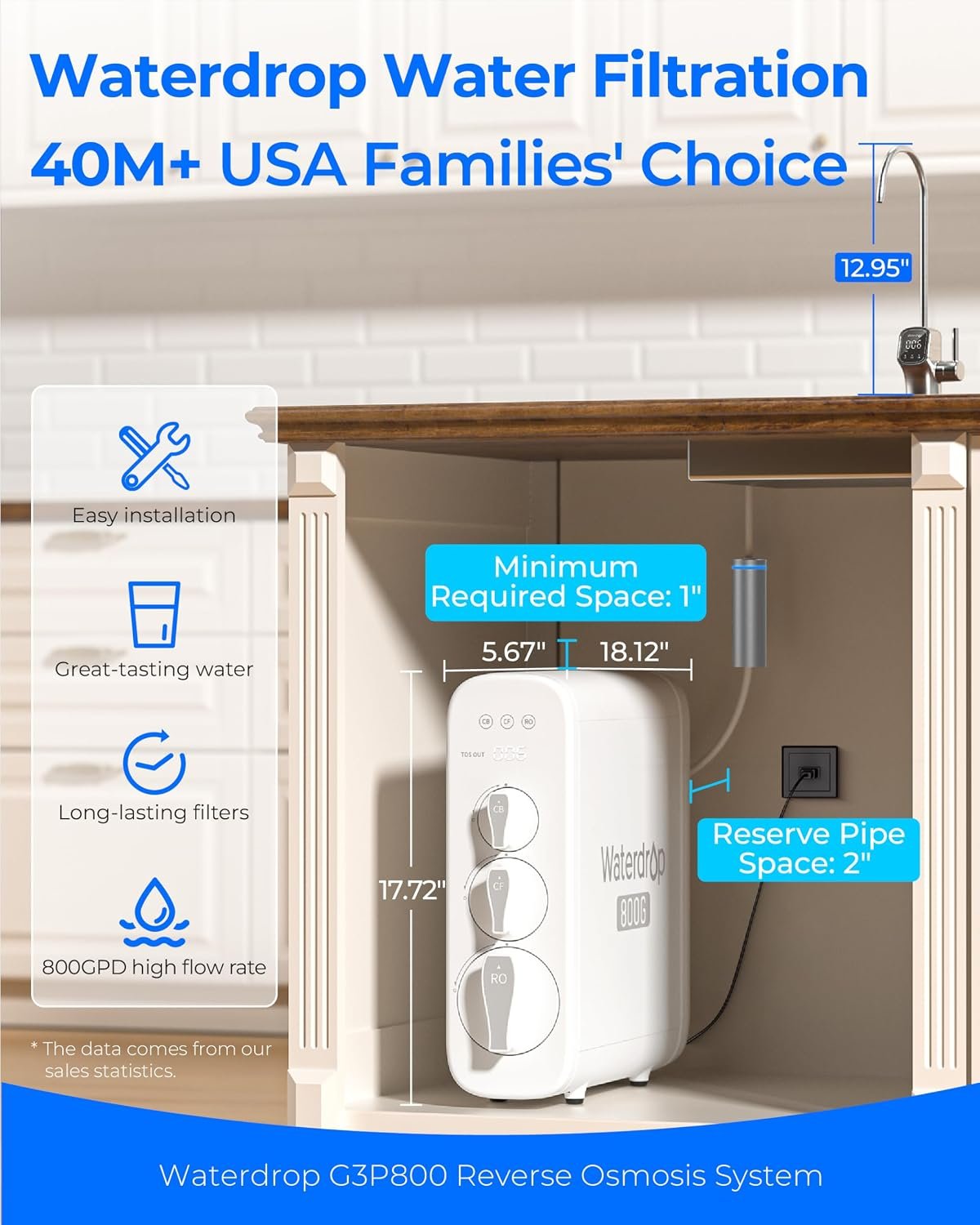
Both systems are tankless and designed for under-sink installation, saving valuable cabinet space. They require an electrical outlet under the sink. The physical dimensions are identical (18.12″L x 5.67″W x 17.72″H), so either will fit in the same footprint. Filter changes are tool-free on both models.
Price and Value
The G3P600 is the more affordable option, while the G3P800 commands a higher price for its increased capacity and filtration. Consider your household’s water needs and budget to determine which offers the best value for you.
FAQ
What is the main difference between Waterdrop G3P600 and G3P800?
The G3P800 has a higher water production capacity (800 GPD vs 600 GPD), more filtration stages (10 vs 8), and a more efficient drain ratio (3:1 vs 2:1). It also includes an automatic LED faucet.
Do both systems require an electrical outlet?
Yes, both the G3P600 and G3P800 are tankless RO systems that require an under-sink electrical outlet to operate.
How often do filters need to be replaced?
According to the manufacturer, filter life varies by usage, but the smart faucet on both models tracks filter life to remind you when to replace them. Typically, pre-filters last 6-12 months, and the RO membrane lasts 2-3 years.
Are these systems certified for contaminant reduction?
Yes, both are certified to NSF/ANSI 42, 58, and 372. The G3P800 is also certified to NSF/ANSI 53 for additional contaminant reduction.
Can I install these myself?
Many Amazon buyers report that installation is straightforward, but if you’re not comfortable with plumbing, professional installation is recommended.
Final Verdict
Waterdrop G3P600 vs G3P800: Which Should You Buy?
If you have a smaller household and want a capable tankless RO system at a lower price, the G3P600 is a great choice. It offers solid filtration and a smart faucet without the premium cost. However, if you need higher capacity, more comprehensive filtration, and better water efficiency, the G3P800 justifies its higher price with a 10-stage system and a 3:1 drain ratio.Ultimately, your decision should hinge on your daily water usage and budget. Both models are well-rated by buyers and share the same space-saving design and ease of maintenance.


