
Solar generators combine a battery-based portable power station with one or more solar panels, giving you a way to keep devices and appliances running without fuel or fumes. In 2026, the market is crowded, but a few bundles stand out for their balance of capacity, output, recharge speed, and panel quality. This roundup focuses on three Anker SOLIX packages that cover very different use cases, from weekend camping to serious home backup.
We did not test these products ourselves. Instead, we compared the manufacturer’s published specifications, listing details, and buyer feedback on Amazon to help you understand what each bundle offers. Where buyers report real-world experiences, we note that those impressions come from reviews rather than from our own use. The goal is to help you match a solar generator to your actual power needs, not just chase the biggest numbers.
Because these are bundle listings, pay attention to what is included: each package pairs a specific power station with a specific solar panel, and in some cases the items ship separately. We explain those differences below so you can compare fairly and avoid surprises at checkout.
Disclosure: reviewilike.com earns a commission from qualifying purchases made through links on this page, at no extra cost to you. Our picks are based on manufacturer specifications and verified buyer reviews; prices and availability change frequently.
Quick Comparison
| Image | Product | Features | Price |
|
Premium Pick
1
 |
Anker SOLIX C2000 Gen 2 + 200W Panel |
2048Wh, 2400W rated/4000W peak, 200W bifacial panel, expandable to 4kWh |
|
|
Best Balance
2
 |
Anker SOLIX S2000 + 400W Panel |
2010Wh LFP, 1500W/3000W peak, 400W panel, 10,000 cycles |
|
|
Best Value
3
 |
Anker SOLIX C1000 Gen 2 + 200W Panel |
1024Wh, 2000W/3000W peak, 200W panel, 9 ports |
Detailed Reviews
1. Anker SOLIX C2000 Gen 2 + 200W Panel – Premium Pick
Amazon rating: 4.7/5 from 741 ratings (at time of writing).
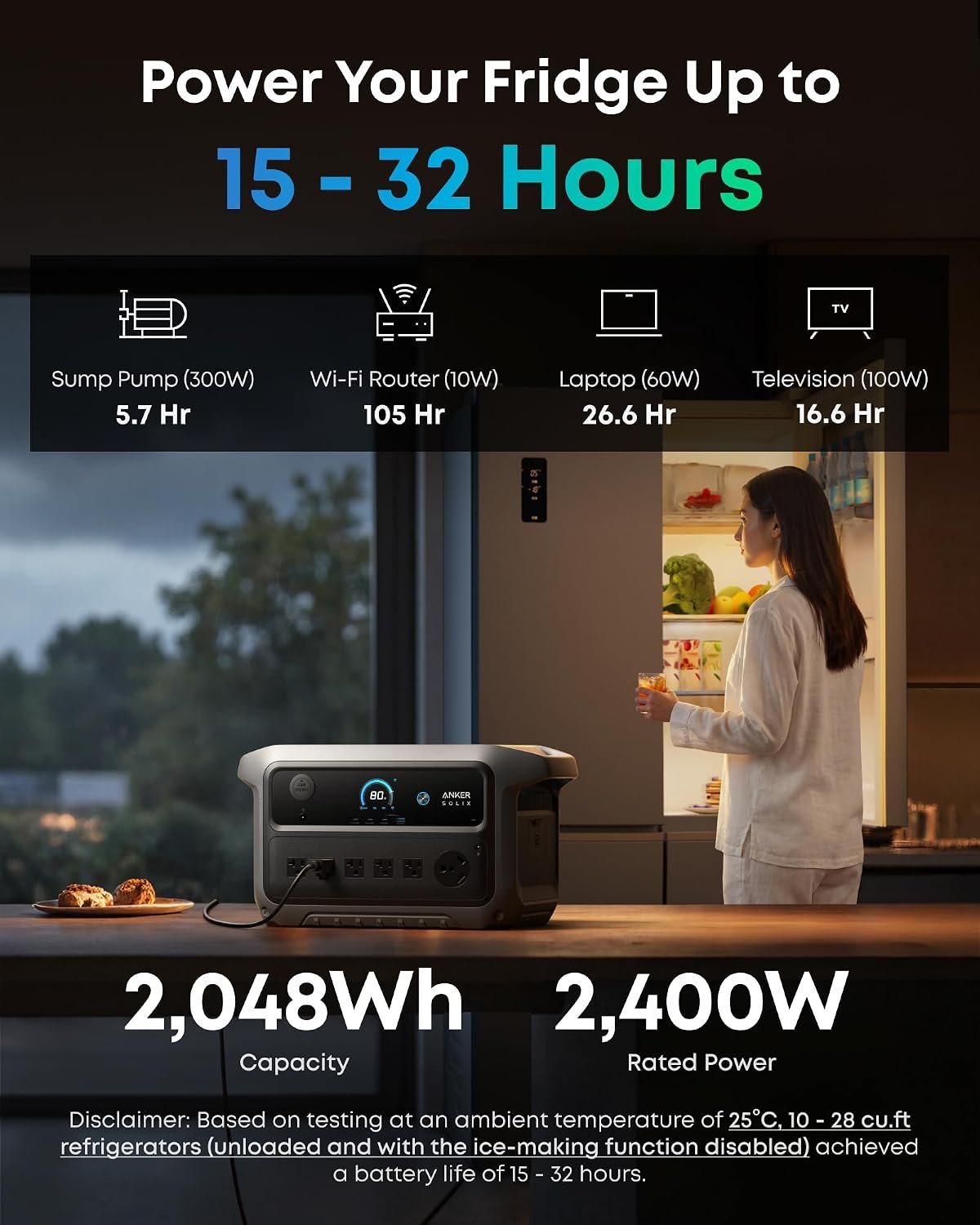
The Anker SOLIX C2000 Gen 2 bundle pairs a 2,048Wh power station with a 200W bifacial solar panel, and it sits at the top of this roundup in both capacity and output. According to the listing, the station delivers 2,400W rated and 4,000W peak power, which the manufacturer says is enough to run multiple appliances at once, including most window and RV air conditioners. The battery is expandable to 4kWh with an add-on battery, and the listing claims a dual-door fridge can run for up to 32 hours on the base capacity, or up to 64 hours with expansion.
Recharging is a headline feature: the listing states the C2000 Gen 2 can reach 100% in 58 minutes using AC and solar together, with 80% in 45 minutes. The included PS200 panel is bifacial, meaning it can generate from both front and rear surfaces, and the manufacturer says it adds up to 10% more output than a single-sided panel. It is also IP68-rated and folds to a compact size at 10.6 lb. Buyers report that the station feels robust and that the fast recharge works as advertised, though some note the two packages may arrive separately.
2. Anker SOLIX S2000 + 400W Panel – Best Balance
Amazon rating: 4.7/5 from 475 ratings (at time of writing).
The Anker SOLIX S2000 bundle combines a roughly 2kWh power station with a 400W bifacial solar panel, and it is positioned as a middle ground between the compact C1000 and the high-output C2000. The listing describes the S2000 as one of the smallest and lightest 2kWh stations, measuring 8.2 × 11.1 × 12.7 inches and weighing 35.7 pounds, which is notably portable for its capacity class. It uses LFP cells rated for 10,000 cycles, and the manufacturer claims a 15-year lifespan under typical use.
Output is listed at 1,500W continuous and 3,000W peak, which the listing says can power 99% of home essentials. The station has eight outlets split between front and rear, and it supports six recharge methods including AC, solar, car, and generator. The included 400W panel is the largest in this roundup, and the listing states the station supports up to 400W solar input. Buyers report that the compact size makes it easy to store and that the UPS switchover under 10 ms works well for home office gear, though some mention the lack of a 12V DC port as a limitation.
3. Anker SOLIX C1000 Gen 2 + 200W Panel – Best Value
Amazon rating: 4.7/5 from 1,771 ratings (at time of writing).
The Anker SOLIX C1000 Gen 2 bundle is the lowest-priced option in this roundup, pairing a 1,024Wh power station with a 200W bifacial solar panel. Despite the lower capacity, the listing shows a strong 2,000W continuous output and 3,000W peak, delivered through nine ports, which makes it capable of running many household devices and small appliances. The station is described as 14% smaller and 11% lighter than similar models, and the LFP battery is rated to retain at least 80% capacity after 4,000 cycles.
Solar recharging is quick for the class: the listing states the C1000 Gen 2 can recharge fully in about 1.8 hours with up to 600W of solar input, and it supports a 10 ms UPS switchover for sensitive electronics like CPAP machines and laptops. The included 200W panel is the same bifacial model as in the C2000 bundle, with IP68 rating and a foldable design. Buyers report that the app-based TOU mode is useful for scheduling power use, and many appreciate the compact form factor, though some note that 1,024Wh fills up quickly with high-draw appliances.
Buying Guide: How to Choose the Best Solar Generator
Capacity and Output: Match the Generator to Your Loads
The first step is understanding the difference between capacity (watt-hours, or Wh) and output (watts, or W). Capacity determines how long you can run something; output determines what you can run at once. A 1,024Wh station like the C1000 Gen 2 can run a 500W appliance for roughly two hours in ideal conditions, while a 2,048Wh station like the C2000 Gen 2 doubles that. Output matters for appliances with motors or compressors, which can draw a surge at startup. Look at both continuous and peak ratings, and compare them to the appliances you plan to power.
Solar Panel Pairing and Recharge Speed
The included panel size directly affects how fast you can recharge from the sun. A 200W panel is a good match for a 1kWh station, while a 400W panel can refill a 2kWh station more quickly. Check the station’s maximum solar input; the C1000 Gen 2 accepts up to 600W, while the S2000 lists up to 400W. Bifacial panels, like the ones in these bundles, can produce extra output from reflected light, but real-world gains depend on placement and conditions. Also consider AC recharge speed if you have grid access, since some stations can refill in under an hour.
Battery Chemistry and Lifespan
LFP (lithium iron phosphate) is the dominant chemistry in 2026 solar generators because it offers long cycle life and better thermal stability than older lithium-ion blends. The S2000 listing claims 10,000 cycles, while the C1000 Gen 2 lists 4,000 cycles to 80% capacity. Cycle life is not the only factor; warranty terms and real-world buyer reports matter too. A longer cycle rating can justify a higher upfront cost if you plan to use the station daily.
Portability, Outlets, and Extra Features
If you plan to move the generator often, weight and dimensions matter. The S2000 is listed at 35.7 pounds, while the C1000 Gen 2 is smaller and lighter. Outlet count and layout also affect convenience; the S2000 has eight outlets split front and rear, and the C1000 Gen 2 has nine. Features like UPS switchover, app control, and time-of-use scheduling can be valuable for home backup, but they add cost. Decide which extras you will actually use before paying for them.
Bundle Differences and Shipping
These listings are bundles, and the power station and panel may ship separately. That is not a defect, but it can be confusing if one box arrives first. Check the “what’s in the box” section for each listing to confirm the exact panel model and cables included. Also note that review counts apply to the bundle listing as a whole, not to each component individually, so avoid comparing review totals across bundles as if they were separate products.
FAQ
What is the best solar generator overall in 2026?
There is no single best for everyone. The Anker SOLIX C2000 Gen 2 bundle offers the highest capacity and output in this roundup, while the C1000 Gen 2 bundle is the lowest-priced and most compact. The S2000 bundle balances a 2kWh station with a large 400W panel. Choose based on your power needs, portability requirements, and budget.
How long does it take to recharge a solar generator with solar panels?
Recharge time depends on panel wattage, sunlight, and the station’s maximum solar input. According to the listings, the C1000 Gen 2 can recharge fully in about 1.8 hours with up to 600W of solar, while the C2000 Gen 2 can reach 100% in 58 minutes using AC and solar together. Real-world times will vary with weather and panel placement.
Can a solar generator run a refrigerator?
Yes, if the capacity and output are sufficient. The C2000 Gen 2 listing claims up to 32 hours for a dual-door fridge on its 2,048Wh battery, and the S2000 listing claims up to 35 hours for a fridge. Actual runtime depends on the fridge’s energy use, ambient temperature, and other loads.
What is the difference between the Anker SOLIX C1000 Gen 2, S2000, and C2000 Gen 2 bundles?
The C1000 Gen 2 bundle pairs a 1,024Wh station with a 200W panel and is the lowest-priced option. The S2000 bundle pairs a roughly 2kWh station with a 400W panel and emphasizes compact size and long cycle life. The C2000 Gen 2 bundle pairs a 2,048Wh station with a 200W panel and offers the highest output and expandable capacity.
Do the power station and solar panel ship together?
According to the listings, the power station and solar panel may ship in separate packages. Anker notes that you may receive one item before the other and recommends tracking the remaining items via the QR code on the package or the provided tracking information.
Final Verdict
Verdict: Which Solar Generator Bundle Is Right for You?
The best solar generator for you depends on how much power you need and how portable you want it to be. If you want maximum capacity and output for home backup or RV use, the Anker SOLIX C2000 Gen 2 bundle is the strongest option here, with expandable capacity and very fast recharge. If you want a balance of capacity, panel size, and portability, the S2000 bundle is a compelling middle ground with a large 400W panel and a compact 2kWh station.For budget-conscious buyers or those who need a compact setup for camping and small devices, the C1000 Gen 2 bundle offers the lowest price in this roundup while still delivering 2,000W output and a 200W bifacial panel. Whichever you choose, confirm the included panel and cables, and remember that manufacturer specs and buyer reviews are your best guide when you cannot see the product in person.


